My dad taught me a lot of things.
Ferrari is best.
Nutella is a meal.
And when it comes to traffic lights...
red means go really fast with your eyes closed.
I always thought that was just one of his jokes.
Because growing up with him, unreasonable wasn't particularly unusual.
Formula One at three in the morning because somewhere on the other side of the planet a bunch of maniacs were about to fire up their engines?
Obviously we're watching.
Cars weren’t little boxes that moved you around.
They had souls.
Some had character.
Some had attitude.
You opened them.
Took things apart.
Welded things.
You figured it out.
And only now, looking back, do I realize what he actually handed me.
Not just a love of machines.
Something way fucking better.
A very questionable relationship with the word “impossible.”
Maybe that's why I recognize so much of myself in these stories.
The people who see every warning light flashing...
and somehow think:
Perfect.
The instructions were clear from day one:
If it breaks...
fix it.
If life knocks the shit out of you...
keep going.
Built Ford Tough wasn't really a slogan in our house.
It was more of an operating system.
Which probably explains why normal never had much of a chance.
Normal is a setting on the washing machine.
I've never been particularly interested in normal.
Normal doesn't build Formula One teams in carpet warehouses.
Normal doesn't keep going after the money is gone, the friends have disappeared and life's just hit you over the head with a shovel.
Normal stops.
And sometimes stopping is sensible.
But nobody ever built anything extraordinary by being sensible.
Look closely enough at extraordinary people and you keep finding wreckage behind them.
The business that failed.
The partner who fucked them.
The money that disappeared.
The humiliation.
The rejection.
The year where absolutely nothing went according to plan.
And sometimes...
real trauma.
The kind that doesn't just damage the business.
It changes the person running it.
And adversity isn't some magical ingredient for success.
Sometimes adversity is just adversity.
Sometimes it destroys people.
But every so often...
you crawl out of it carrying something you didn't have before.
Perspective.
Independence.
A frightening tolerance for discomfort.
A reduced interest in other people's approval.
And perhaps the most dangerous thing of all:
proof that you can survive.
Once you know that...
fear is fucked.
You've called its bluff.
That's what fascinates me now.
Not success.
The refusal before the success.
The point where virtually every piece of available evidence says:
This isn't working.
You're not qualified.
You're too old.
You're too broke.
You're too late.
Someone else already owns the market.
They have more money.
They have better technology.
They have a bigger factory.
They have connections.
They have Ferrari.
And yet the unreasonable ones look at all of that and say:
Yeah.
I'm going anyway.
That's why I started these stories.
Actually...
it's becoming a series of series.
Because there are different versions of the same disease.
THE UNREASONABLE ONES
The people who believed in something when almost nobody else could see it.
The late bloomers.
The rejected.
The broke.
The written-off.
The people who held onto the dream long after respectable society had recommended they get a proper job.
People who were prepared to look completely ridiculous...
right up until the moment they didn't.
SMALL FACTORY. BIG BALLS.
Same spirit.
Different battlefield.
Tiny companies.
Garages.
Sheds.
Workshops.
A couple of dudes with a welder and an attitude problem.
Standing across from corporations with thousands of employees and budgets large enough to have their own weather systems.
The little factory isn't supposed to win.
That's exactly why I love it when it does.
And sometimes the stories overlap.
Because the company usually inherits the insanity of the person who started it.
Frank Williams is perhaps the perfect example.
A man who refused to stop...
building a company that refused to know its place.
Which is why his story belongs to both.
Maybe that's ultimately what all of these stories are about.
Not cars.
Not racing.
Not business.
Not money.
Belief.
Believing in yourself when there is very little evidence supporting the theory.
Getting up when nobody would blame you for staying down.
Starting again when starting again feels humiliating.
Continuing when you've lost the advantage.
And occasionally discovering that what looked like the end of your story...
was actually the start.
So this series is for the unreasonable ones.
The people rebuilding.
The people three feet from gold who have absolutely no idea they're three feet from gold.
The little factory surrounded by giants.
And anyone currently standing in the wreckage wondering whether they have one more round left in them.
You probably do.
And if you need proof...
meet Frank.
FRANK WILLIAMS
1942-2021
THE MAN THEY COULDN'T GET RID OF
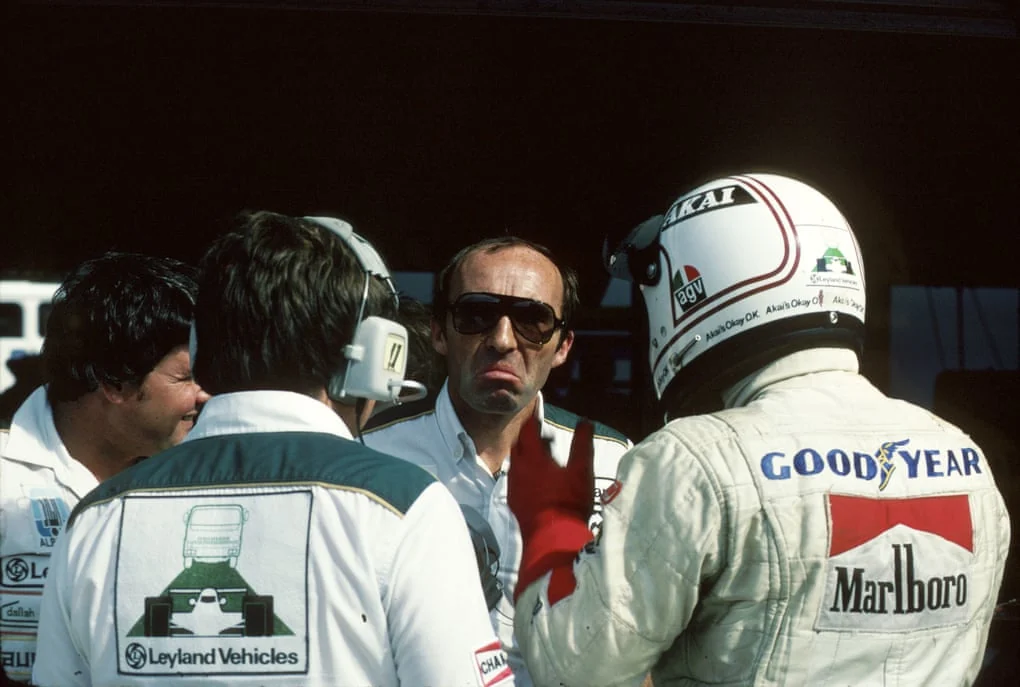
As a kid, I thought I was watching racing.
Now that I'm an old man, I realize I was watching something else.
People.
Stubborn ones.
Fearless ones.
The kind who get knocked flat, wipe the blood off, and somehow decide the correct response is:
Again.
And the older I get, the more of myself I see in some of these people.
But perhaps none more than Frank Williams.
1969.
Old-school Formula One.
For decades, Formula One was run by maniacs.
That was the whole point.
McLaren arrived at Monaco towing its F1 car behind a station wagon.
By the '80s, Williams Honda had built a 1,200-horsepower qualifying monster.
Which is exactly what happens when you leave maniacs unsupervised for twenty years.
The maniacs built the cars.
The maniacs drove them.
The maniacs ran the teams.
The asylum was functioning perfectly.
Frank's is one of my favorite stories from that insane era.
He taught me that sometimes the only sensible reason to keep going...
is because everything is telling you to stop.
If you've never heard of Frank Williams, that's fine.
Most people haven't.
Just understand this:
Formula One is one of the most expensive, technically ridiculous sports ever invented.
Ferrari.
McLaren.
Lotus.
Hundreds of engineers.
Factories.
Wind tunnels.
Mountains of money.
And at one point, Frank Williams was trying to compete with them...
from a phone booth.
Not figuratively.
His factory telephone had been disconnected because he couldn't pay the bill.
So Frank walked down the road, climbed into a phone booth and kept running his Formula One team.
Ferrari had Maranello.
McLaren had proper telephones.
Frank had loose change.
Before Formula One, Frank sold Campbell's soup.
He sold fruit and vegetables from a van.
Which is not the traditional feeder series into Formula One.
Frank started in canned goods.
He wasn't an engineer.
He wasn't a brilliant racing driver.
He wasn't rich.
What he had was something much better:
A belief he belonged in Formula One.
His closest ally was a talented young driver named Piers Courage.
In 1969, Frank's tiny private team finished second in Monaco.
Then second again at Watkins Glen.
Suddenly this scruffy little operation looked dangerous.
Then came Zandvoort, 1970.
Courage crashed.
The car caught fire.
Piers Courage was killed.
Frank didn't just lose his driver.
He lost his friend.
And this is where these stories usually end.
The dream has extracted its price.
You go home.
You grow up.
You find something safer.
Frank Williams kept racing.
What followed was years of getting kicked directly in the balls.
Bad cars.
Bad deals.
Sponsors disappearing.
Creditors.
Debt collectors.
At one point Frank missed a repayment date.
A blue Transit van arrived.
Three men got out.
Walked into the factory.
Picked up one of Frank's Cosworth Formula One engines...
and carried it away.
Frank found the money.
Got the engine back.
Of course he did.
His daughter, Claire, remembered a story that summed him up perfectly.
Frank was sent out for fish and chips.
He came home with...
spark plugs.
Dinner had somehow turned into racing parts.
Which is funny.
Until you realize everybody around Frank was living inside the obsession too.
Especially his wife, Ginny.
Because while Frank was figuring out how to get the next car onto the grid...
Ginny was figuring out how to keep their actual life from collapsing.
When the money ran out, she sold her own apartment to keep his racing alive.
Then hid the bills from him so he wouldn't have to see just how bad things had become.
Think about that.
Most people will support your dream...
right up until the dream starts eating the furniture.
Eventually the paddock stopped seeing him as the plucky underdog.
They started laughing.
"Wanker Williams."
"Startline specialist."
Because on some weekends, simply getting one of Frank's cars to the grid counted as progress.
Then the money finally swallowed him.
Canadian oil millionaire Walter Wolf came in.
Frank needed the lifeline.
Wolf was not, unfortunately, a charity.
The surname may have been a clue.
Wolf took control.
Frank Williams became an NPC inside Frank Williams Racing.
His name was still on the door...
but he was basically an employee in his own dream.
Frank left.
And just to make sure the knife went all the way in...
Wolf's team entered the first Grand Prix of 1977.
And won.
The fucker wins immediately without him.
That‘s not bad luck.
That’s the universe personally taking the piss.
There are moments when the signs could not be clearer:
Give up.
Frank heard:
Start another Formula One team.
Frank needed someone who could actually build the car.
That someone was Patrick Head.
Patrick could build racing cars.
Frank could somehow find enough money to let him.
That was basically the business plan.
They found an old carpet warehouse in Didcot.
No technology center. No marble lobby. Just old carpet, no money, and Frank starting over.
And on the day they arrived to begin their new Formula One empire...
they couldn't get inside.
So Frank Williams and Patrick Head broke into their own factory.
Their entire first-year budget was about £180,000.
For the whole Formula One team.
In Formula One terms, that's less a budget than a dare.
But, Frank Williams had one almost supernatural ability:
he could survive long enough for good things to happen.
Then. The FW07.
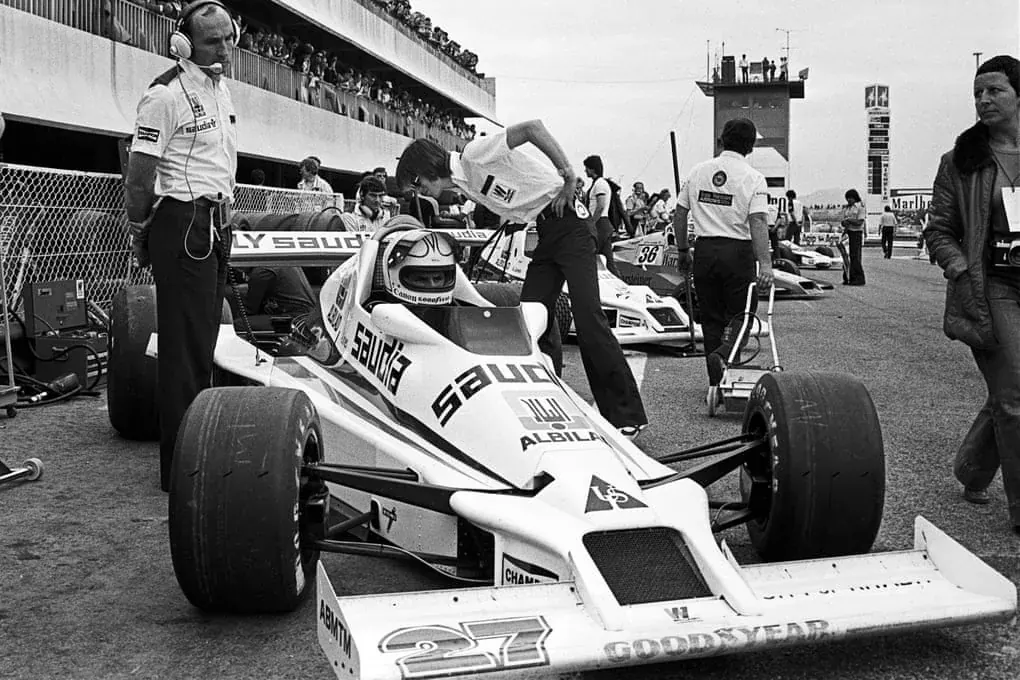
And suddenly...
the joke wasn't funny anymore.
At Silverstone in 1979, Clay Regazzoni - a racing driver equipped with a magnificent mustache and apparently no fear whatsoever - crossed the finish line first.
Williams had won a Formula One Grand Prix.
For the first time.
The phone-booth team.
The repo-engine team.
The carpet-factory guys.
Winners.
Then won four of the final six races.
And one year later...
1980.
Just three years after Frank had lost his first team...
Williams became Formula One World Champions.
Drivers' Championship.
Constructors' Championship.
The soup salesman...
had beaten Ferrari.
And this would be a perfectly good ending.
But Frank Williams apparently selected Expert Mode when he installed life.
By 1986, Williams wasn't an underdog anymore.
It was becoming a monster.
Honda power.
Nigel Mansell.
Nelson Piquet.
The FW11.
Williams no longer looked like a scrappy little racing team.
Williams had gone from begging to be on the grid... to owning the fucking thing
And Frank himself was fit af.
He ran constantly, often jogging around circuits after everyone else had gone home.
Then came March 8, 1986.
After testing at Paul Ricard in France, Frank was driving toward the airport.
His rental car left the road.
It rolled.
Frank broke his neck.
He could not move.
The man who loved running...
was paralyzed.
He was 43 years old.
Doctors were not sure he would live.
At one point his condition was so grave that withdrawing life support was discussed.
Ginny refused.
Give him the chance to fight.
She knew exactly what sort of man was lying in that bed.
Frank fought.
Doctors reportedly thought another ten years would be remarkable.
Frank lived another thirty-five.
But first...
he wanted his Formula One team back.
Friday, July 11, 1986.
British Grand Prix weekend.
Four months after the crash, Frank Williams was wheeled into the press room.
Around 300 people stood.
The same paddock that once called him Wanker Williams...
was on its feet.
And apparently Williams had decided subtlety was unnecessary.
Qualifying:
Piquet - 1st.
Mansell - 2nd.
Then race day, Sunday, July 13:
Mansell - 1st.
Piquet - 2nd.
One-two on the grid.
One-two at the finish.
Four months after he broke his neck...
Frank Williams was still in charge of the asylum.
And this is the ridiculous part.
The accident didn't finish the Williams story.
Some of its greatest years hadn't even happened yet.
Williams went on building cars so dominant that on certain weekends the rest of Formula One looked like a joke.
Eventually:
9 Constructors' Championships.
7 Drivers' Championships.
114 Grand Prix victories.
Frank lost Piers Courage.
Kept going.
Ran out of money.
Kept going.
Had his telephone disconnected.
Found a phone booth.
Had his engine repossessed.
Found another engine.
Lost the company carrying his own name.
Started another one.
Had no proper factory.
Found a carpet warehouse.
Couldn't get inside.
Broke in.
Got laughed at.
Built a car.
Beat Ferrari.
Became World Champion.
Then broke his neck.
Lost the use of his body.
And somehow...
kept going again.
Most of us spend our lives waiting for things to line up.
More money.
Better timing.
The right connection.
A bit of luck.
Some sign that we're finally allowed to go.
Frank Williams spent half his life receiving one instruction:
Stop.
Frank simply never seemed to understand it.
And maybe that's why his story hits harder as you get older.
Because eventually all of us get hit.
Dreams go wrong.
People leave.
Money disappears.
Bodies fail.
Plans collapse.
The world usually doesn't give you some great cinematic comeback.
It just asks:
Are you still here?
Frank always was.
Life took his money.
His team.
His reputation.
His mobility.
It knocked him down in almost every way a man can be knocked down.
But it could never quite get rid of him.
And eventually...
that fight passed to his daughter.
Claire grew up inside the asylum.
The factory.
The pit lane.
The wins.
The disasters.
She knew exactly what the name WILLIAMS meant.
Which was useful, because in 2013, at 36 years old, somebody essentially handed her one of the most famous Formula One teams on Earth and said:
Good luck with that.
Her mother had just died.
Her father was disabled.
The team was struggling.
And Formula One was still overwhelmingly run by men who'd spent their entire lives arguing about aerodynamics and looking disappointed at laptops.
No gentle handover.
No easing into it.
Sunday came...
and Claire had to run Williams Racing.
So she did.
Because apparently the Williams family response to impossible situations was:
Deal with it.
But Claire didn't inherit Frank's Formula One.
She inherited the end of it.
Frank's world was garages.
Small factories.
Men with pencils.
Men with enormous balls.
Claire's world was billionaire money, simulation centers and industrial empires with wind tunnels.
The little family team wasn't fighting other little racing teams anymore.
It was fighting what Formula One had become.
And she fought like hell.
Not just to keep Williams alive.
To keep the asylum in the hands of the maniacs.
Eventually...
the family had to sell.
Claire kept the team alive.
Kept people working.
Kept WILLIAMS on the grid.
But this wasn't just a company.
It was her dad.
Her childhood.
The factory.
The name over the door.
Claire later said it felt like
“someone cut my heart out and it’s never been returned.”
Fuck.
I can't even imagine.
She saved Williams...
by giving it away.
And for me, that was when old Formula One finally died.
The racing continued.
Of course it did.
But the world where a couple of lunatics could break into an old carpet warehouse, build a car and go beat Ferrari...
was gone.
For decades, Formula One was run by maniacs.
Then one day...
the adults sanitized it and brought Netflix.
And somewhere between selling soup...
a disconnected telephone...
a repossessed engine...
an old carpet warehouse...
and nine Formula One World Championships...
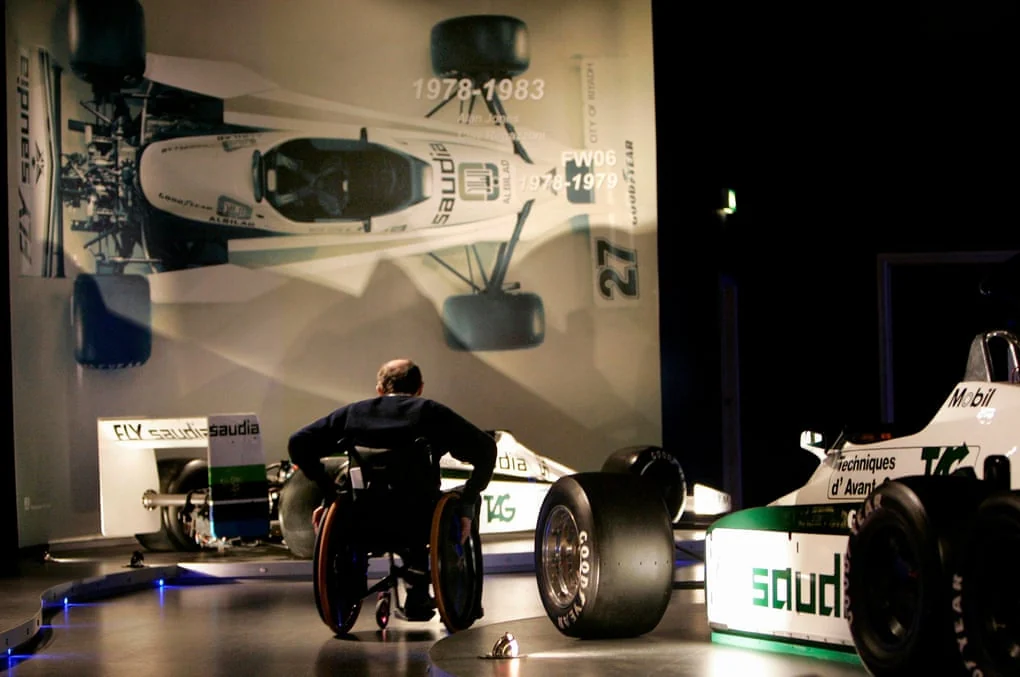
"Wanker Williams" became Sir Frank Williams.
The sport changed.
The maniacs eventually disappeared.
But for one glorious era...
they ran the whole damn place.
Frank Williams was one of the very best of them.
Thank you, Frank.
For showing us how to keep going...
when everything says stop.
And thank God the adults arrived late.
Old Formula One is gone.
The maniacs aren't.
Now we have new machines.
And a giant carpet warehouse.
The old rules are fucked.
School?
A joke.
Diplomas?
Great.
Hang it on the wall beside the student debt.
Meanwhile some dude in sweatpants has twelve bots running...
a business launching...
and scalped 62% profit on Gold futures while he was asleep.
Hell yeah.
Because the little guy finally has weapons.
Stuff that used to need entire teams and trust fund babies
can now happen from a laptop at 2:17 in the morning.
With or without tequila.
This is the first story.
There'll be more.
The maniacs.
The machines.
The crazy shit I'm building before the grown-ups find out.
Because they eventually sanitize everything.
They can have this one...
when we're finished with it
Frank had a carpet warehouse.
We have Wi-Fi.
And now...
— Stephen